TO SUBMIT: Send pitches to tinycutlery@gmail.com
I was at work thinking about the color palette
for an event to be branded. Previously the discussion had been, “We don’t have time, just make everything black & white,” which for an architectural organization is not an altogether bad or unexpected choice. However, now the issue arose where more than two different tones were needed; categories were emerging, and labels and sponsor tiers and all the stratifications of society and work and projects that graphic design aims to serve, solve, or absolve.
So we needed colors. But whose?
My colleague brought up AI — that we could pinpoint a color we “liked” just a cursor and generate dozens of complementary color combinations. And then, “just pick one.”
Of course this is how design happens all the time. And I’m not saying this would have produced a horrific result. But it made me again caution us to slow down; who really needed color today, anyway? Isn’t that what primary colors are here for us for — they offer an immediate and always relevant system by which to categorize things?
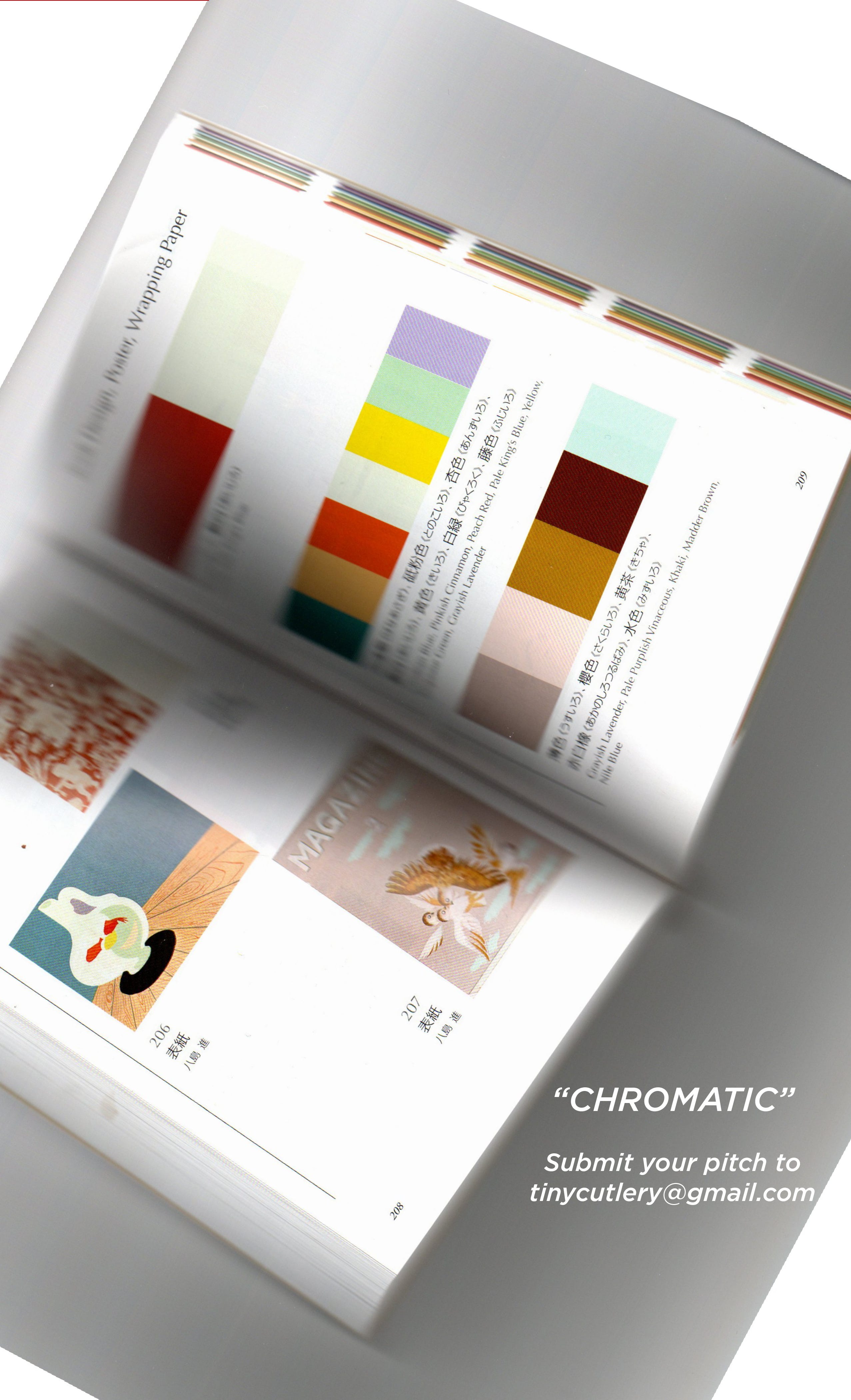
I then went home and just now opened one of my favorite things: the Japanese hand-held book called “Dictionary of Color Combinations.” I happen to have Vol. 2.
I assume many of you will see the call for Starters Season 04 being Chromatic and immediately jumped to discussions about color. And you wouldn’t be wrong. But the real intrigue I found with this word was in an off-chance reading somewhere (it might have been Notecards by Morya Davey, recommended to me by someone I admire more than almost anyone). It espoused the secondary definition of Chromatic, the one being “the use of accidentals” and/or falling outside the “traditional scales.” Semitones, half-steps, errant flats and sharps.
If Starters is always seeking writing that doesn’t fit the editorial calendar or sits outside the PR newsworthy mode, aren’t these writers just as chromatic? This is new design storytelling: We’re sick of the slick surfaces, the images that we can’t tell are renderings or photographs, the perfect quotes written by interns and assistants, the spoon-fed pitches and fighting for social media-fueled relevance.
As always, these are the goals of writing within these pages. But for the first time, I’m opening up the next season to an open call — I can’t wait to meet you all and your stories.
— Emily Conklin, editor