
Stone Song
Peter Walhout

This is what seeing this work demands from us: to be whole with the land, to see the land in our walls and our food and our clothes and ourselves.
On the thirty-third story of a gutted FiDi office tower, I crouched below the floorboards of a traditional Japanese house. I was with the house-builder’s family, and we were complaining about the surroundings that held his work captive. Talking about the ways of the world as they should be is a regular occurrence for the Yangs. My first impressions of this family were gleaned some years ago from an apartment previously shared by two siblings: a sister and brother. I was the budding boyfriend to that sister, and my sojourns to that apartment brimmed with intensity. In their third-story home was a disused fireplace; hearth replete with milled blanks of hardwood, river stone, and kozo paper. Hand-planed wooden ribbons strewn over wide floorboards and airy Akari lamps floated about, shifting locations between my visits. The house-builder, Thomas, would sit at the workbench adjacent to the fireplace, quietly subtracting, chiseling, sharpening, hammering, and clicking. Eventually siblings went separate ways, and Thomas’ pieces moved from their living room to showrooms.
Time passed after their split and I continued to be mystified, as I was in that apartment, by the many shades of Thomas’ practice. I already knew his background: Montreal-born, of Taiwanese and Northern Italian heritage. A furniture designer. Once, we spoke about his attention—he seemed to me to have preternatural patience, evinced in his love for craft methods that have been automated or outmoded: dovetailing, hide glue, etc. Surprisingly, he confided that his talent is not for uninterrupted focus, but for deception. He repeatedly tricks himself into believing that the task at hand is the final one, the ultimate product in and of itself. This is in stark contrast to the experienced fabricators I have labored with in different manners of shops, who seem to work with a steady attitude rather than in bursts. Thomas’ methodology felt immature. At the same time, this impatience is one reason that scribing has emerged as a central technique in Thomas’ practice. A scribe—a traced subtraction of one object to fit an irregular form of an adjoining object—is an entirely specific act, never repeated the same. The pieces that incorporate this technique are always imagined as one of one—not unrepeatable so much as they are utterly, inexorably specific.
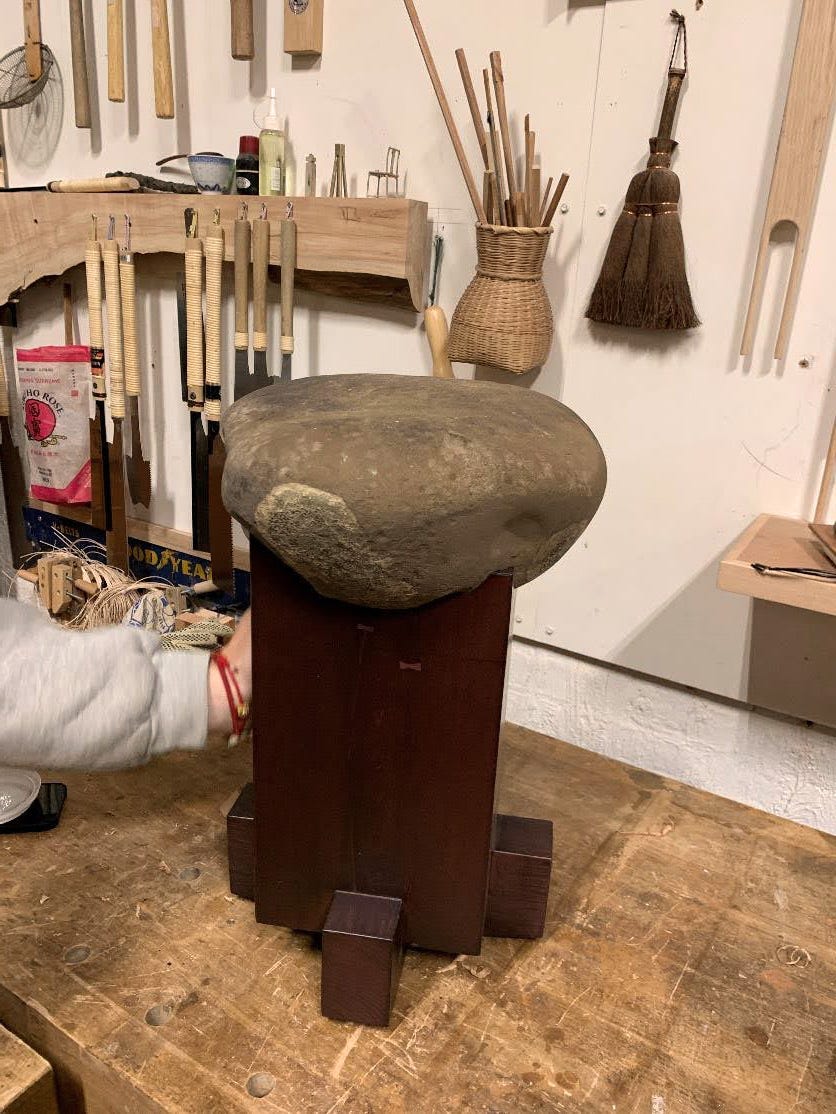
On a frigid January day, Thomas visited me at my office–a metalwork-millwork shop close to his studio–and showed me a maquette of a new project. Two parallel, swept feet below a vertical length of massive, clear grained dimensional lumber. Its top end was scribed to fit the contours of a smooth stone that cantilevered delicately on all sides: the massive seat of a “rocking chair.” I know this object was influenced by traditional Japanese architectural order. What I could not have known is how enchanting it would be.
Ishibadate is a technique used in traditional Japanese house construction. It describes the carved connection where a wooden foundation post meets a carefully selected stone footing below. Organized in a grid, these make up the foundation of a building. Seeing this piece was like cracking the shell of an egg and discovering a membrane-y, white circle suspended in a generous sea of yolk. An absurd subversion, formally and conceptually.
Keep reading with a 7-day free trial
Subscribe to Starters to keep reading this post and get 7 days of free access to the full post archives.